

Much ado about geoengineering
Exploring the semantic and substantive debates


Today we’re excited to publish a guest post from one of the sharpest voices in climate, Nick Van Osdol. Nick is founder and editor in chief of Keep Cool, an investor at Climate Capital, and communications lead for Renaissance Philanthropy's Advanced Research for Climate Emergencies (ARC) Initiative and the Climate Emergencies Forum (make sure to follow ARC’s great Substack). This is the second time Nick has graced us with a guest post. He builds on our latest post on geoengineering and expands on the activity percolating in this broad space. We hope you enjoy!
I spent the past three weeks in Germany, first in Berlin visiting cousins and friends and then visiting my Grandma in the tiny, quiet town in the middle of the woods in the southwest.
Germany is no stranger to climate change discussions; it assumed a leadership posture on the energy transition decades ago by making substantial commitments to renewable energy. Of course, it has also made plenty of ill-advised blunders, like shuttering eighteen nuclear power plants, a misstep it’s now routinely lambasted for on social media.
That said, I’ve never seen the country on the vanguard of the most cutting-edge trends with respect to any tech segment. German startups are, for instance, basically wholly absent from the ranks of leading AI and AI research labs. So I was surprised to see a full-page spread in Die Zeit, one of Germany’s most-read newspapers, covering climate interventions recently.
The article took a rather skeptical tone (sardonic even). Its title roughly translates to “Last resort: Megalomania,” to offer a shallow, broad overview of some of the types of “geoengineering” proposals increasingly percolating in academic, non-profit, and even private-sector circles. It looks at a few different ideas, ranging from an oft-cited example of damming the Bering Strait to protect the Atlantic meridional overturning circulation (AMOC) from destabilization to glacier thickening and ice sheet stabilization proposals.

The German article is not the only one to take a skeptical look at the resurgence in geoengineering. There’s been considerably more discussion recently from both U.S. and U.K.-based researchers who tend to conclude that geoengineering is a bad idea. They posit that even baseline research should be conducted quite cautiously, and perhaps put on hold altogether.
See, for instance, Ted Norhaus’ recent “Why I Oppose Solar Geoengineering” and Raymond Pierrehumbert, Julia Slingo, Michael Mann and Valerie Masson-Delmotte’s “trust our expert warnings on geoengineering’s planetary risks” in the Guardian. Against this backdrop, and given the Cooler’s recent newsletter discussing the re-emergence of geoengineering in the climate tech zeitgeist, I figured I’d offer my perspective into both the semantics and substance of increasing momentum for “geoengineering,” (as I’ve explored elsewhere, there’s a good case for dropping this term”).
Semantic problems in the geoengineering debate
Before we look at some of the substance behind the latest resurgence of interest and even investment in geoengineering, let’s settle a few semantics. Because the geoengineering discourse warrants a semantic evolution.
There are two common ways in which geoengineering, as a blanket term, leads to some problems. For one, it is often used as a metonymy, where “geoengineering” really stands in for stratospheric aerosol injection (SAI). This is the main deficiency of the two most recently referenced articles (above). Those articles, which are quite critical of geoengineering, focus predominantly on the risks associated with global SAI, which include the spatial variability and unpredictability of some of its likely impacts, such as disruptions to monsoon patterns in regions that depend on that rainfall for agriculture, as well as the risk of a “termination shock” dynamic if deployments were stopped suddenly, and uncertain second and third order impacts.
These are valid concerns about SAI, but they don’t necessarily apply directly to other climate intervention strategies. The question here is simple: Why not just say SAI and not geoengineering?
“Climate interventions” is probably the better term for what is really a diverse bucket of strategies, which differ considerably from one to the next in their scale, mechanisms, reversibility, temporality, and how easy it is to attribute and monitor their impacts. This is why a one-size-fits-all criticism of geoengineering, née, SAI, doesn’t make sense. Lumping a bunch of disparate strategies together and characterizing the risks thereof as consistent with the level of risk that SAI poses is, most charitably, bad reasoning, and least charitably, borders on bad faith.
Jessica Seddon and colleagues at the African Tech Futures Lab recently published a useful taxonomy of many dozens of different “climate intervention” strategies, including familiar examples like SAI and marine cloud brightening as well as other examples that will likely be less familiar to many, such as Methane Removal / Oxidation Enhancement and Ocean Albedo Modification (OAM) (Microbubbles / Foam).
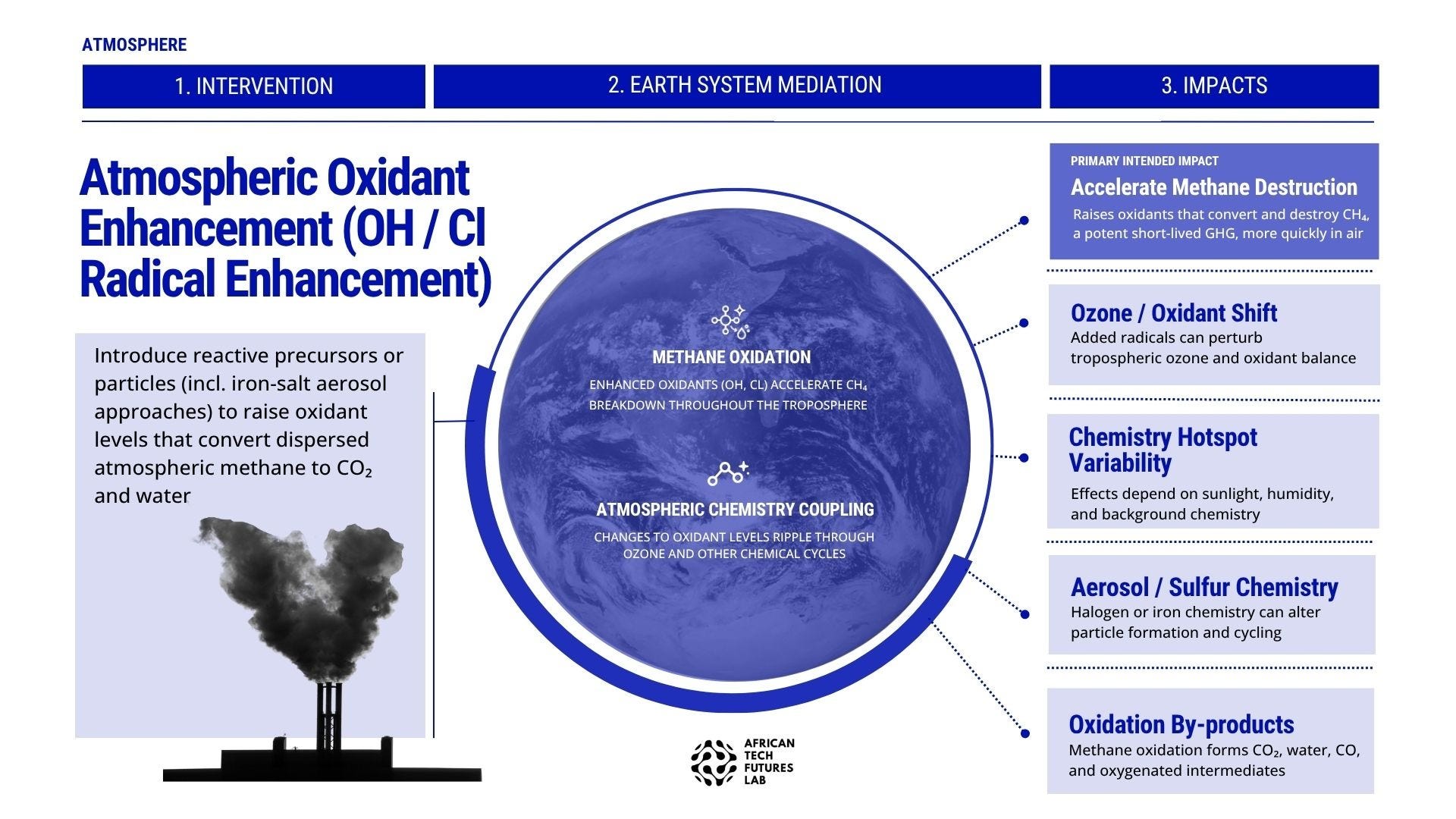
They define climate interventions as specific, human actions made in time and space that are designed to produce an impact on physical Earth systems. This differs from mitigation in that they’re not efforts to reduce the impact of anthropogenic actions on Earth systems (e.g., efforts to reduce greenhouse gasses) or efforts designed to make infrastructure more resilient to a changing climate (adaptation).
Whatever you call it, interest in interventions is increasing
If there’s one thing that all this debate and discussion, whether of geoengineering or climate interventions, implicitly agrees on, it’s that there is growing momentum for research and development and even private-sector company formation and investment in this space.
One reason activity in this space is accelerating is the rate of change in the challenges certain solutions and sets of actions are designed to address. The rate at which the world is warming has roughly doubled since 2015. Predictably, this also means that many of its consequences, such as sea level rise, are accelerating, too.
Moreover, as global warming accelerates, it also brings a specific category of associated risks into starker relief. Whereas the first-order impacts of global warming and climate change include many readily appreciable consequences, like extreme heat and sea level rise, the complexity of Earth’s climate systems and how subcomponents of it interact with one another also gives rise to second and third order impacts and risks, some of which could be even more catastrophic. An example of such risks are tipping points, which are thresholds beyond which components of Earth’s climate systems are at risk of entering irreversible transitions to new, significantly altered states of equilibrium and function.
The world is even less prepared for these types of risks than it is to accelerate mitigation and adaptation. A lot of capital (some $2 trillion) is allocated to mitigation efforts every year now to do things like build and deploy solar panels, sell electric cars, etc… But carbon dioxide is a long-lived atmospheric gas—it lingers in the atmosphere for centuries.
As long as greenhouse gas emissions are above zero, mitigation is more comparable to easing our foot of the global warming gas pedal rather than actually pumping the brakes. The world has already warmed 1.4°C and is on pace for ~2.8°C based on current estimates of future emissions trajectories, which take continued progress on mitigation into account. In fact, coral reefs may have already crossed their tipping threshold, which, if true, would mean ~99% of them face certain doom. If more tipping points are at risk at, say 2°C of warming, what’s the plan to intervene? Existing mitigation and adaptation efforts may not suffice.
The increase in interest in climate interventions sits downstream from these physical realities. In the past few years, an Israeli startup, Stardust, has raised $60 million to develop technology for stratospheric aerosol injection (though they propose using more proprietary particles rather than sulfur dioxide). Real Ice, a privately-funded company also supported by the U.K.’s Advanced Research and Invention Agency (ARIA), has drilled holes in ice and pumped ocean water up onto the ice’s surface to rethicken it. Other startups have raised millions for weather modification, including several working on cloud seeding (to make more rain), and another that’s focused on hurricane and tropical cyclone mitigation.
Then there’s the non-profit sector, in which there are dozens of relatively new research programs, funds, and incubators focused on at least assessing, if not also conducting outdoor testing, of stabilizing strategies. There are organizations like the one I work for, Advanced Research for Climate Emergencies (ARC), which acts as a philanthropic venture studio to incubate programs to accelerate research and development for interventions and resolve critical uncertainties in climate science. For example, one of our programs, the Arctic Stabilization Initiative, has raised $6 million towards a multi-year, stage-gated research program to assess whether targeted interventions like mixed-phase cloud thinning (MCT) can reduce risks like sea ice loss and Greenland Ice Sheet destabilization in the Arctic, which is warming four times faster on average than the rest of the Earth.
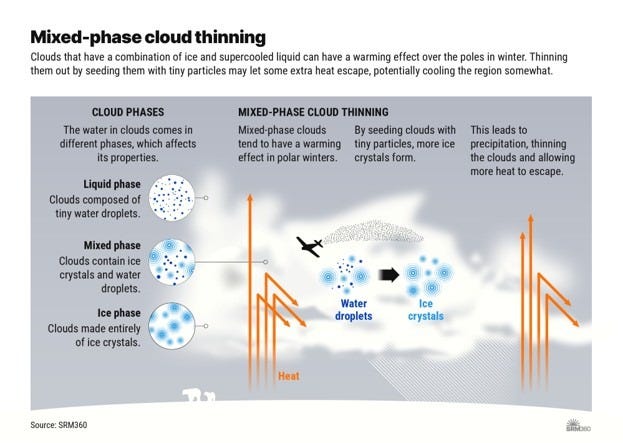
An overview on mixed-phase cloud thinning (MCT). Credit: SRM360
Other larger-scale programs in the non-profit sector include ARIA’s £56.8m program designed to assess a range of interventions and the University of Chicago’s Climate Systems Engineering initiative (CSEi), which has initial commitments of $36M+. As evidenced by the ARIA funding, some of which comes from the U.K. government, national governments are paying attention increasingly, too. Last year, Iceland declared the risks facing AMOC, a critically important system of ocean currents, a national security threat. This was the first such instance in which a national government elevated a specific climate risk to the national security register. Which links us back to where we started this article; proposals like daming the Bering Strait, as far fetched as they may seem, are intended to reduce pressure on systems like AMOC that are increasingly at risk.
What to watch for in the years ahead
To be sure, the numbers here are still diminutive compared to other fields. Intervention research receives less than 0.1% of philanthropic given for climate generally, and pales by many orders of magnitude in comparison to the venture capital flooding into other sectors in climate and energy, such as nuclear fission and fusion, where dozens of pre-revenue companies have raised hundreds of millions over the past twelve months alone. Going a step further, compared to AI, likely the starkest example, the fledgling growth of the intervention space barely registers as a blip. One could almost conclude that all the debate about geoengineering, interventions, whatever we call them, is much ado about nothing.
Still, I’d like to believe that, considering the stakes, climate interventions, or at least research, will continue to grow as a meaningful pillar of climate action. Adaptation and carbon removal were both once derided as distractions from mitigation. Yet, as the physical realities changed, they were increasingly accepted and more funding was allocated to them. It’s certainly possible and, from my vantage point, desirable that intervention research follow the same trajectory. But if there’s one area I know for sure that interventions will continue to punch above their weight, it’ll be in stirring debate. Unfortunately, the hand-wringing about whether any of this is responsible is unlikely to go away. The real question is whether academics, scientists, and other practitioners will be able to find enough common ground or set certain things aside long enough to find some common ground on a shared vision for the field and alignment on a set of shared norms and goals.
The alternative is that the same old debates about terminology, moral hazards, or whatever else will suck up all the time and oxygen, turning would-be funders away and stalling progress. There are even several parallel efforts to put moratoriums on research of interventions, regardless of what the research agenda actually entails. This may seem like an attempt at risk management, but it also risks propagating a scientific vacuum that makes unilateral actions and geopolitical conflicts they’re likely to breed more likely in the future. At some point we must accept that, facing catastrophic climate risks, we will need to take risks at some point. Supporting research and science strikes me as a conscionable place to start.
Finally… here are some of the stories we’ve been telling:
⚛️ Making fusion commercially-viable
Heatmap goes inside Inertia’s roadmap to commercial fusion, exploring how the company plans to transform Lawrence Livermore’s breakthrough ignition experiments into a grid-scale power plant by the mid-2030s. Instead of chasing another scientific milestone, Inertia is tackling the engineering challenges that stand between the lab and the real world. The thinking: fusion has proved it can work; now it’s finally time to make it economical.
🏭 Rethinking carbon capture for heavy industry
In an op-ed for the World Economic Forum, Mantel CEO Cameron Halliday argues that industrial decarbonization won’t come from deploying more of today’s carbon capture technologies; it will require solutions built specifically for high-temperature industrial processes. His case is simple: if carbon capture is going to scale across the industries responsible for nearly 70% of industrial CO₂ emissions, it needs a fundamentally different approach.
🏠 Why the future of the grid starts at home
On the Climate CEOs podcast, Lunar Energy CEO Kunal Girotra argues that distributed energy only succeeds if it delivers value to homeowners before the grid. The conversation explores why intelligent software (not just batteries) is essential for coordinating thousands of homes with different energy needs, enabling virtual power plants that lower customer bills, provide backup power, and strengthen the grid without asking homeowners to compromise.
⚡️ Power is becoming AI’s biggest bottleneck
On the latest episode of Aurora Energy Research’s Energy Unplugged podcast, Verse CEO Seyed Madaeni argues that AI’s biggest infrastructure challenge isn’t chips, it’s electricity. As demand collides with years-long grid interconnection queues, he explains why software, flexible energy resources, and smarter grid planning will determine which data centers get built first, and why “speed to power” is becoming the next competitive advantage.
For more recent reading on the types of climate risks and potential intervention opportunities Nick and his team at ARC are thinking about, check out their latest Substack post on risks facing and posed by the weakening of AMOC (and what to do about it today).